How it worksfor leaders, teams and the organization.
AI fluency is the ability to understand, use and adapt to AI in your own work. The program answers three questions: what people learn, who makes it stick, and how it keeps going. It grows from personal use to the whole enterprise, in three phases.
What we do,question by question.
WhatWhat do we drive fluency around?
One foundation for everyone, then learning built for each role
Everyone gets the same foundation. After that, learning is specific to the role. Persona paths are built from interviews with the people who do the work, so exercises use their tasks, data and risks. Playbooks and challenges give people a reason to practice.
What changes
Role-relevant capability with a clear progression from first use to helping others.
- Foundations for every employee: concepts, safe use, prompting, judging outputs
- Persona paths with levels of advanced learning, built from persona interviews
- Learning-by-doing playbooks: prompt-a-thons and hackathons on real tasks
- Daily challenges and weekly quizzes
- A tool layer for the AI platform you have approved
- Your policies, terminology and examples built into the content
AI fluency maturity
WhoWho champions it?
Leaders, champions and learners, turning together like gears
Three groups have to move together. Leaders role-model AI and set the direction. Champions (managers, trainers and early adopters) turn that direction into team habits. Learners build the skill through practice and feedback. Vision flows down, and adoption momentum flows back up.
What changes
A leadership team with agreed commitments, teams with AI norms and a recurring ritual, and learners who share what works.
- Leaders: individual pre-meets, then executive sessions on business value, architecture, data and Human-AI chemistry
- Leaders: a 30/60/90-day plan with named commitments, and a one-page guide on good AI use for their teams
- Managers: a toolkit to set expectations, model new ways of working and help the team apply AI
- Trainers and early adopters: advanced learning, coaching and recurring sharing sessions
- Learners: learn the foundation, practice in low-risk settings, apply AI to daily tasks, share what works
- A communications toolkit that explains why the program exists
Three groups
HowHow do we embed and sustain it?
Technology, governance and rituals that keep pace with AI
Three things keep the program going after launch. Technology: a hub people visit, an agent they can ask, and a cockpit leaders use to steer. Governance: guardrails, oversight and clear accountability, so AI is used safely as it changes. Process and rituals: a cadence that refreshes learning, evolves workflows and brings new ideas into use.
What changes
One place for learners, one source of evidence for leaders, and a capability you own with named owners and a cadence.
- Technology: Engagement Hub, CAiRA the Learning Agent in Teams and the hub, and the Value & Adoption Cockpit with four layers of evidence
- A five-belt certification path, visible in the hub
- Governance: standards, controls and approved use cases for AI
- Governance: named accountability for safe use, and risks and controls reviewed as AI changes
- Process and rituals: learning content refreshed as tools change, and workflows adapted to new capabilities
- Process and rituals: a repeatable intake to evaluate and deploy new AI ideas, as a route into agentic process redesign
Three parts
Fluency starts with your own workand reaches how the organization runs.
AI for everyoneAI for the enterprise
AI product and tool deployment. People apply the approved AI tools to their own work and know when to check, challenge or escalate an output.
Usually in FoundationAI for the enterprise
- 5Enterprise operating model and governanceThe organization makes deliberate choices about roles, decision rights, investment and governance.Usually in Embedded
- 4Entire functionsA function such as finance or HR redesigns how its work is done with AI and agents.Usually in Embedded
- 3Use cases and workflowsTeams apply AI to shared tasks, and a sequence of work changes, with AI handling defined steps and people reviewing the result.Usually in Scaling
AI for everyone
- 2Persona and role-based useLearning and practice are built for each role, so a finance analyst and a plant supervisor each work on their own tasks.Usually in Foundation
- 1AI product and tool deploymentPeople apply the approved AI tools to their own work and know when to check, challenge or escalate an output.Usually in Foundation
Building fluency takes learning programs that
- 1Build a shared foundation, with gamification and social energy as the catalyst
- 2Use engaging material that keeps evolving
- 3Teach by doing, in the flow of work
Leaders, champions and learnersturn together, like gears.
Interconnected parts
Fluency happens only when all three gears turn together.
Ripple effects, both ways
Vision flows down, and adoption momentum flows up.
Compounding momentum
As adoption begins, fluency builds on itself.
Leaders
Executives and senior leaders
Role-model AI fluency and guide the transformation: individual pre-meets, an executive program and a 30/60/90-day plan with named commitments.
Champions
Managers, trainers and early adopters
Managers embed behaviors
They turn priorities into team action: set expectations, reinforce new ways of working, and help people bring AI into daily work.
Trainers build capability
They build advanced expertise and spread it through coaching, targeted guidance and informal learning.
Early adopters create momentum
They explore new tools, test new ways of working, share feedback and show how AI applies to everyday work.
Learners
The broader workforce
- 1Learn. A foundation in AI, responsible use and the available tools.
- 2Practice. Experiment in low-risk settings to build confidence.
- 3Apply. Bring AI into everyday tasks to improve quality and problem-solving.
- 4Create value. Share what works and contribute to team and organizational outcomes.
How leaders shift, from their own work to the enterprise
For leader conversations: how leaders work (head) and how they lead (heart).
| Scope | Head shift: how leaders work | Heart shift: how leaders lead |
|---|---|---|
| Foundation: a common language | A shared AI foundation: mindset, productivity and use cases | The role of leaders: co-create the organization's why story |
| AI for me | Day in the life: apply AI to your own work and projects | Psychological safety: address concerns and fears about AI |
| AI for the team | Team practice: set expectations and practice on real work | Functional leadership: build team rituals and a culture where failing safely is fine |
| AI for the enterprise | Enterprise value chain: redesign how people and AI create value | Culture of experimentation: build experimentation into daily work |
| The road ahead | Enterprise roadmap: set priorities and next steps | Leadership activation: commit to an AI-fluent organization |
Technology, governance and ritualsthat keep pace with AI.
Tech and data
Tools that bring fluency into daily work and measure adoption and value.
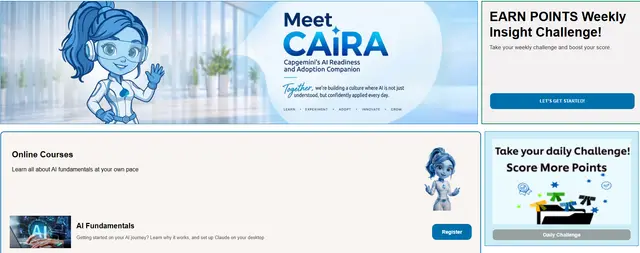

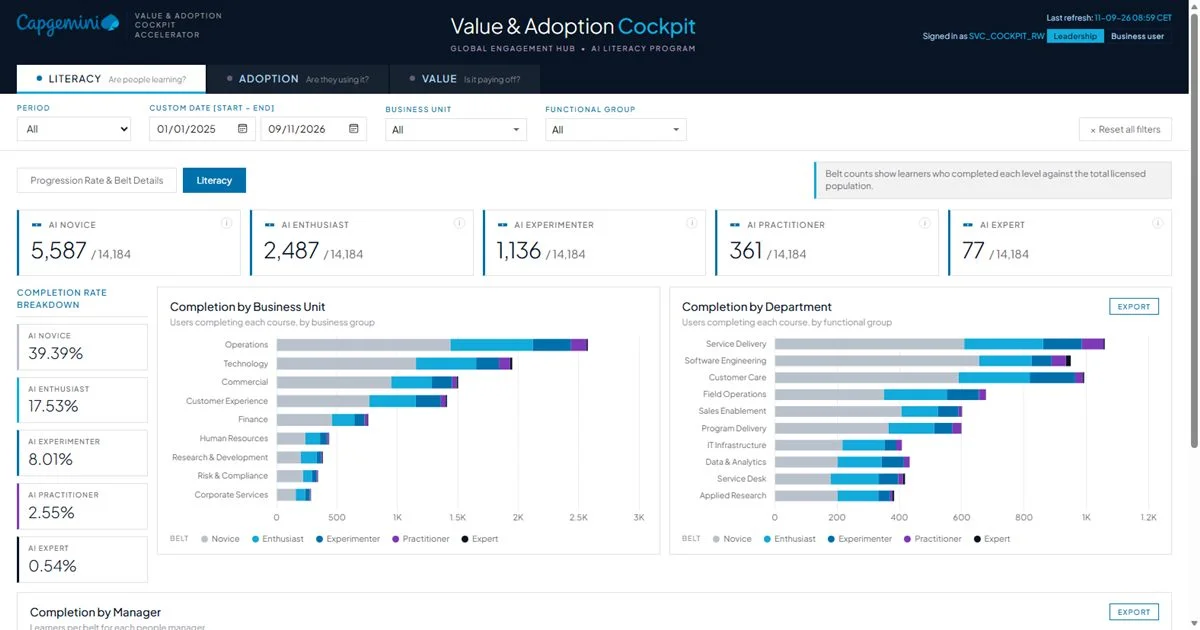
Capgemini demonstrator and cockpit demo, synthetic data.
Governance
The framework to scale AI safely, responsibly and within your standards.
- AccountabilityClear responsibility for AI safety, compliance and governance decisions.
- GuardrailsStandards, controls and approved use cases for AI across the organization.
- OversightRisks reviewed and controls adjusted as AI capabilities change.
Process and rituals
The cadence that keeps capabilities, learning and adoption moving.
- 1. Refresh learningKeep content, guidance and good practice current as AI changes.
- 2. Evolve workflowsAdapt ways of working to new AI capabilities and opportunities.
- 3. Scale innovationA repeatable way to evaluate, prioritize and deploy new AI ideas.
Five belts,each one opening the next.
Learning, practice and visible behavior all count. Belts show progress in the hub and in the cockpit. They are never used to assess individual performance.
- White belt
AI literacy and safe use
How to earn
- Literacy
- Foundations pathways
- Gamification
- One weekly quiz
- Reinforcement
- Not required
- Yellow belt
AI experimentation
How to earn
- Literacy
- Experimenter pathway and two learning labs
- Gamification
- Five daily challenges
- Reinforcement
- One manager kudos
- Green belt
Applied AI proactivity
How to earn
- Literacy
- Practitioner pathway
- Gamification
- Ten daily challenges and a prompt-a-thon
- Reinforcement
- Two manager kudos
- Blue belt
AI implementation
How to earn
- Literacy
- Expert pathway
- Gamification
- A hackathon
- Reinforcement
- Lead one fluency initiative
- Black belt
Enterprise AI transformation leader
How to earn
- Literacy
- Support learning labs and drive adoption in a function
- Gamification
- Ten daily challenges and a weekly quiz
- Reinforcement
- Lead three fluency initiatives
Literacy: training completion. Gamification: streaks and leaderboard. Reinforcement: behavior demonstrated.
Three phases, from a pilot groupto an AI-native organization.
- 1Near term
Foundation
A pilot group is enabled
- Set the plan for AI enablement
- Build the core learning assets
- Run the first hands-on pilots
Works toward: A common language and the core assets.
- 2Mid term
Scaling
A wider population is enabled
- Build out the full set of enablers
- Learning paths for every fluency level
- First wins with specific AI products and use cases
Works toward: Compliance and risk under control, and employee productivity.
- 3Long term
Embedded
Ongoing enablement
- Communities of practice that sustain themselves
- Learning that keeps pace with innovation
- Governance built into how work is done
Works toward: Cost reduction, revenue and innovation.
What you bring
- An executive sponsor
- Business and persona representatives for interviews and reviews
- Access to the approved AI tools for learners and facilitators
- Capacity to publish learning in your LMS
- Owners for content, data and support
Responsible use
- Learning and the agent use only approved tools and approved content.
- Engagement and learning data are reported in aggregate. They are never used to rank or assess individual employee performance.
- Estimates are labeled as estimates, and data freshness is shown.
Platforms
Built and proven on Microsoft Copilot.
The framework and content carry to Claude and Gemini. Integrations are adapted and tested per platform.
For other AI platforms, we assess fit and integration effort with you before committing to scope.